Help?
support@expertscentre.com
+61 470 540 416
Monday-Friday: 9-5pm AEST
Location:
Craigieburn 3064 VIC - Australia.
Graphican.com Pty Ltd TA Experts Centre
ABN: 29630287642

Help?
support@expertscentre.com
+61 470 540 416
Monday-Friday: 9-5pm AEST
Location:
Craigieburn 3064 VIC - Australia.
Graphican.com Pty Ltd TA Experts Centre
ABN: 29630287642


You spend hours perfecting your resume. You apply for positions where you’re clearly qualified. Yet you hear nothing back. This frustrating experience is common in today’s Australian job market, and often, the reason isn’t personal—it’s automated.
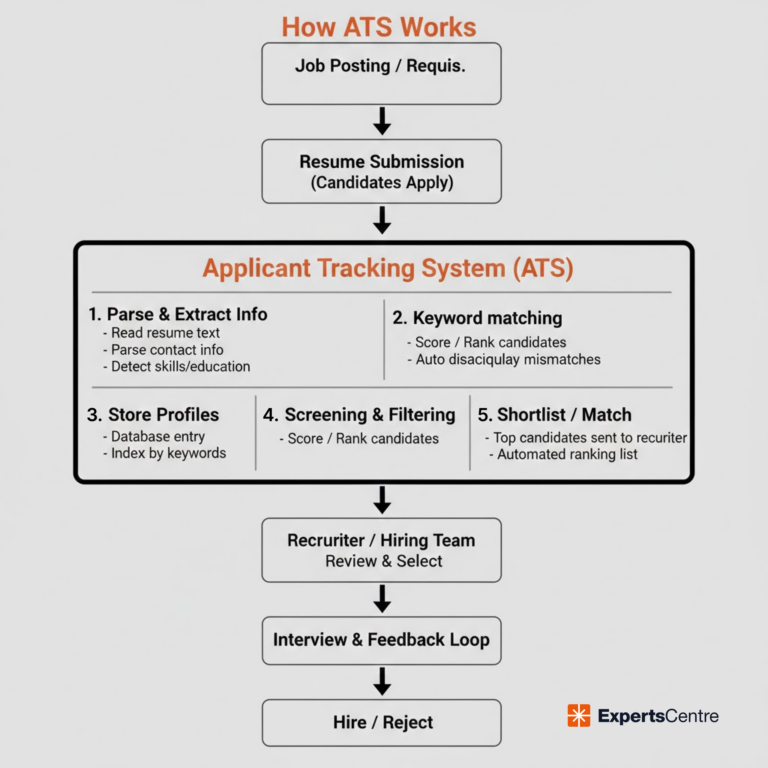
Most companies in Australia now use Applicant Tracking Systems (ATS) to manage job applications. This software acts as a digital gatekeeper, scanning and filtering resumes before they reach human recruiters. Understanding how it works in our local context is essential for any serious job seeker.
An Applicant Tracking System is software that helps employers manage the hundreds of applications they receive for each role. Its main job is to scan each resume for specific criteria based on the job description. In Australia, these systems typically look for:
Even well-written resumes can fail ATS screening for several reasons common in our market:
The ATS looks for exact matches with words from the job description. If your resume uses different terms—even if they mean the same thing—it may not score well.
Example: If the job asks for “experience with Xero” and your resume says “accounting software experience,” the ATS may not recognise the match.
Complex formatting can confuse ATS software. Elements like:
These can cause the ATS to misread or skip important information in your Australian resume.
Both ATS systems and Australian recruiters respond better to specific achievements. Vague descriptions of duties don’t carry the same weight as concrete results with numbers that show real impact.
Carefully review the job description and identify the most important terms. Include these naturally throughout your resume, particularly in:
Don’t just list keywords—incorporate them into descriptions of your actual work in a way that makes sense for Australian employers.
Replace general duty statements with specific, measurable results that Australian employers value.
Instead of: “Responsible for increasing sales”
Write: “Increased regional sales by 22% over six months through strategic client outreach, adding $150,000 in new business”
Numbers provide clear evidence of your impact and often contain relevant keywords that the ATS recognises.
Michael, a project manager in Brisbane, applied for 20+ positions without a single callback. His resume was strong but used international project management terminology. The specific Australian job ads he targeted mentioned “local council approvals” and “Australian standards compliance.”
We helped Michael revise his resume to include these exact phrases in his achievement statements. We also simplified his formatting to meet Australian ATS requirements and added metrics to his results. Within four weeks of submitting his optimised resume, he received two interview invitations from Brisbane-based firms.
The difference wasn’t his experience—it was how his resume communicated that experience to both the Australian ATS systems and local hiring managers.
The Australian job market has particular characteristics that affect ATS optimisation:
Generic online advice often misses these nuances. At ExpertsCentre, we specialise in the Australian and New Zealand markets. Debra O’Brien and her team understand exactly what local ATS systems look for and how Australian recruiters evaluate candidates.
Our Resume Upgrade Package provides strategic optimisation based on current Australian hiring practices. We ensure your resume passes automated screening while presenting your strongest case to Australian decision-makers.
“I didn’t realise how much my international resume was working against me in the Australian market until ExpertsCentre showed me the local ATS perspective. With their optimisation, I went from complete silence to multiple interviews in weeks,” says Priya, an engineer now working in Sydney.
The ATS is now a standard part of hiring in Australia. Rather than seeing it as a barrier, you can learn to work with it effectively. By optimising your resume for both digital screening and Australian human review, you significantly increase your chances of being seen and selected for interviews.
Your qualifications deserve to be evaluated fairly in our local market. Don’t let automated screening prevent your resume from reaching the right people.
Ready to ensure your resume passes the Australian ATS test?
👉 Get Your Australian Resume Professionally Optimised
References:

Meet your Resume Expert
Upgrade your resume into one recruiters can’t ignore