Help?
support@expertscentre.com
+61 470 540 416
Monday-Friday: 9-5pm AEST
Location:
Craigieburn 3064 VIC - Australia.
Graphican.com Pty Ltd TA Experts Centre
ABN: 29630287642

Help?
support@expertscentre.com
+61 470 540 416
Monday-Friday: 9-5pm AEST
Location:
Craigieburn 3064 VIC - Australia.
Graphican.com Pty Ltd TA Experts Centre
ABN: 29630287642


You took time away from work. Perhaps you raised children, cared for an ageing parent, recovered from illness, or simply needed a breather after years of continuous work. Now you’re ready to return, but that gap on your resume feels like a glaring problem.
Here’s the truth: career breaks are common, and they don’t have to hold you back.
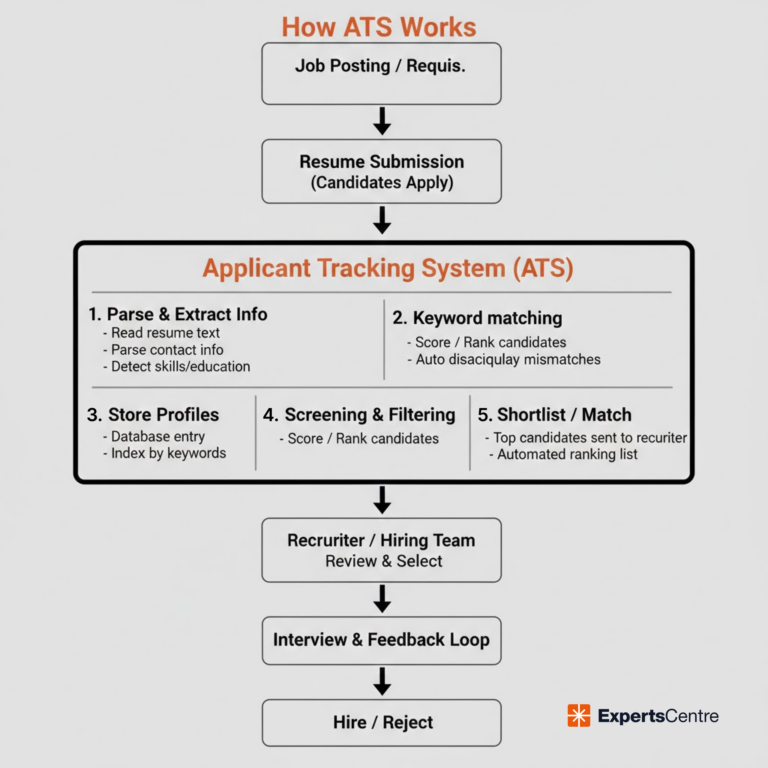
According to Harvard Business School’s Hidden Workers research, employment gaps affect up to 48% of job applicants. In Australia, where ATS software screens most resumes before human review, how you present these gaps can determine whether your application moves forward or gets filtered out.
Hiring managers and ATS systems look for consistent work history because it suggests reliability and current skills. An unexplained gap raises questions:
These concerns are understandable. But a well-presented career break can address them before they’re even raised.
In the Australian market, honesty works best. Trying to hide a gap by djusting dates or leaving periods unexplained often backfires. Background checks and reference calls will reveal the truth, and employers value integrity highly.
Instead, own your break and present it strategically.
Think about what you accomplished during your time away. Most career breaks involve valuable transferable skills:
| During Your Break | Skills You Developed |
|---|---|
| Raising children | Time management, budgeting, negotiation, crisis management |
| Caring for a relative | Organisation, patience, healthcare coordination, advocacy |
| Travel | Adaptability, cross-cultural communication, planning |
| Illness recovery | Resilience, self-management, prioritisation |
| Study | New knowledge, discipline, research skills |
| Volunteering | Teamwork, community engagement, specific task skills |
These are not empty years. They are periods of growth that shaped who you are.
Don’t leave months or years blank. Include the period in your employment history with a clear, professional label.
Instead of:
2019–2021: [Blank]
Use:
2019–2021: Career Break — Full-Time Parenting
Every experience teaches something. Identify skills from your break that apply to your target role.
For a return to administration:
2020–2022: Career Break — Family Care
For a return to management:
2021–2023: Career Break — Relocation & Community Volunteering
Demonstrate that you maintained professional awareness during your break.
Example:
Throughout my career break, I:
Your resume should emphasise readiness to return, not just explain the past. Close your career break section with a statement about your current focus:
“Now fully available and eager to apply my organisational skills and recent professional development to a challenging role in office administration.”
Not all career breaks are positive experiences. You may have dealt with illness, redundancy, or personal challenges you’d rather not detail on paper.
That’s completely fine. You can be honest without being specific.
Use a simple, professional description:
2020–2021: Career Break — Personal Health
Successfully managed recovery and return to full-time availability. Used this time for professional development including [specific course or skill].
This approach maintains honesty while protecting your privacy.
Will the ATS penalise you for a career break? It depends on how you present it.
Most ATS systems in Australia scan for:
A well-written career break section that includes relevant keywords and shows continued development can actually work in your favour. It demonstrates self-awareness and the ability to frame challenges positively — qualities Australian employers value.
At ExpertsCentre, we understand that careers aren’t always linear. Life happens. The best candidates often have rich life experiences that make them more capable, not less.
Our Resume Upgrade Package is designed specifically for Australian job seekers with complex career histories. We help you:
Debra O’Brien and her team have helped hundreds of Australians return to work after career breaks. We know what local employers and ATS systems look for.
“After five years at home with my children, I was terrified my skills were obsolete. ExpertsCentre helped me see what I’d actually learned during that time and present it professionally. Within a month, I had two job offers.” — Sarah, returning mother, Melbourne.
Every professional journey has chapters. Some are about climbing the ladder, and some are about stepping back to focus on what matters. Both have value.
The key is presenting your complete story in a way that Australian employers understand and appreciate. With the right approach, your career gap becomes not a weakness but evidence of your resilience, adaptability, and life experience.
Ready to present your career journey with confidence?
👉 Get Your Resume Professionally Optimised

Meet your Resume Expert
Upgrade your resume into one recruiters can’t ignore