Help?
support@expertscentre.com
1300 455 090
Monday-Friday: 9-5pm AEST
Location:
Craigieburn 3064 VIC - Australia.
Graphican.com Pty Ltd TA Experts Centre
ABN: 29630287642

Help?
support@expertscentre.com
1300 455 090
Monday-Friday: 9-5pm AEST
Location:
Craigieburn 3064 VIC - Australia.
Graphican.com Pty Ltd TA Experts Centre
ABN: 29630287642

If you are applying for roles in Australia or New Zealand and hearing nothing back, you are not alone. Many capable professionals submit dozens of applications and receive no response, not even a rejection.
This frustration often has less to do with experience and more to do with how resumes are screened. Most medium to large employers now use Applicant Tracking Systems, or ATS, to manage high application volumes. These systems decide which resumes move forward before a recruiter ever sees them.
Research from Harvard Business School shows that millions of qualified candidates are excluded early in hiring processes due to how automated screening systems operate. Understanding this reality is now part of being job-ready.
Despite the myths, ATS software is not artificial intelligence that “judges” people. It is primarily a matching and ranking system.
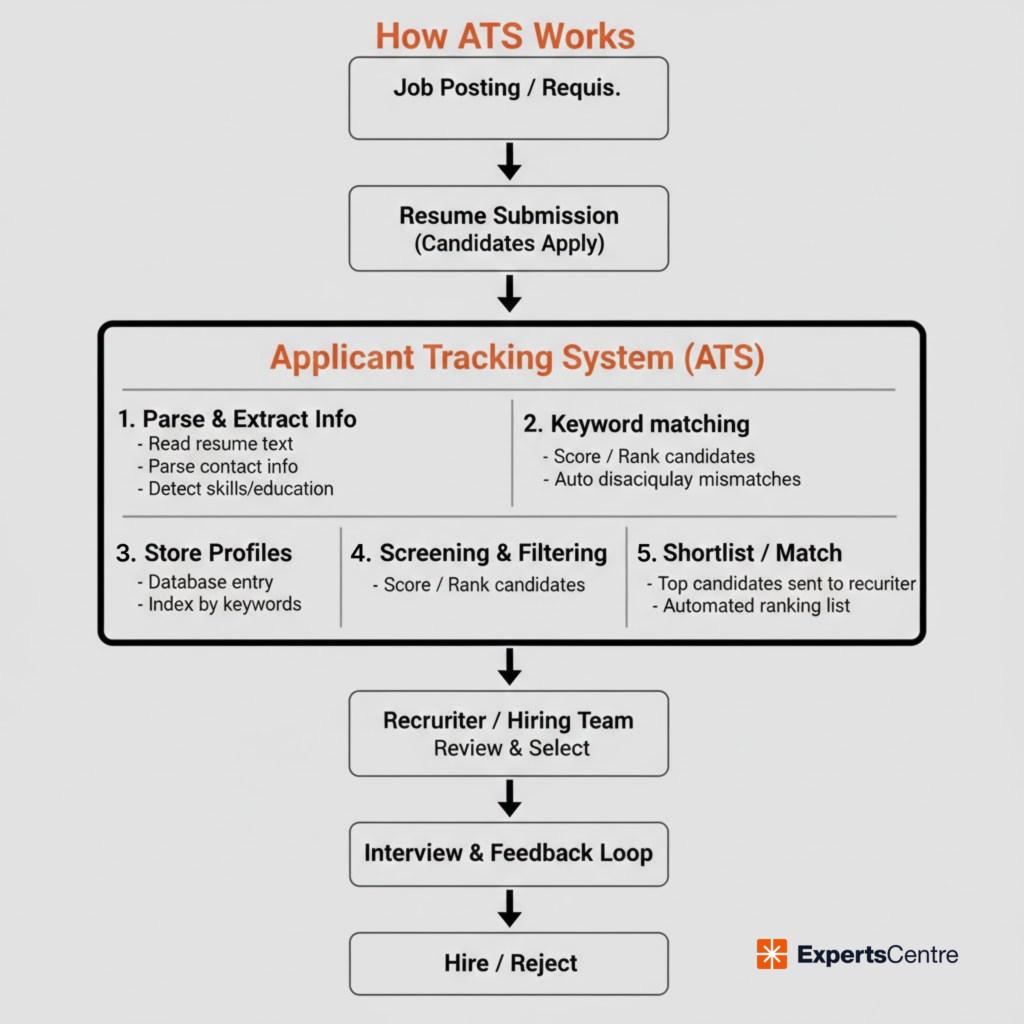
Specifically, an ATS does four things:
Therefore, resumes that are unclear, generic or poorly structured tend to fall below the review threshold.
Harvard Business School’s Hidden Workers report found that 88% of employers believe qualified candidates are filtered out by screening systems before human review.
This happens for several reasons:
According to Debra O’Brien, a senior recruiter with over 15 years’ experience, “Most resumes that fail ATS screening don’t lack experience. They lack clarity. Recruiters can only work with what the system surfaces.”
Debra’s experience reviewing thousands of resumes across Australian and ASX-listed organisations reinforces what the research shows. ATS systems reward precision, not potential.
Consider a project manager applying for roles in Melbourne. Their resume emphasised leadership and delivery but avoided technical language. Job descriptions, however, consistently mentioned terms like “risk register”, “RAID logs” and “Prince2”.
Once the resume was rewritten to reflect the same experience using market-aligned terminology, it began passing ATS screening and led to interviews. The experience never changed. The presentation did.
ATS platforms are evolving, but not in the way many assume. While machine learning is being introduced, the core logic remains matching and ranking.
Emerging trends include:
This means resumes will increasingly be evaluated on how clearly skills and outcomes are expressed, not on narrative flair.
There is no trick. There is only alignment.
Practical steps include:
Most importantly, treat your resume as a decision document, not a biography.
ATS systems are not the enemy. They are the gate.
Once you understand how they work, you stop fighting the process and start working with it. For many professionals, that shift alone is enough to change the trajectory of a job search.
If you want a recruiter’s perspective on how your resume performs against modern screening systems, the ExpertsCentre Resume Upgrade Package is designed to do exactly that.