Help?
support@expertscentre.com
1300 455 090
Monday-Friday: 9-5pm AEST
Location:
Craigieburn 3064 VIC - Australia.
Graphican.com Pty Ltd TA Experts Centre
ABN: 29630287642

Help?
support@expertscentre.com
1300 455 090
Monday-Friday: 9-5pm AEST
Location:
Craigieburn 3064 VIC - Australia.
Graphican.com Pty Ltd TA Experts Centre
ABN: 29630287642


You’ve heard the advice: “Use keywords to beat the bots!” So, you stuff your resume with every technical term and job title you can think of, hoping the computer will give you a high score.
But what if this common tactic is actually making things worse?
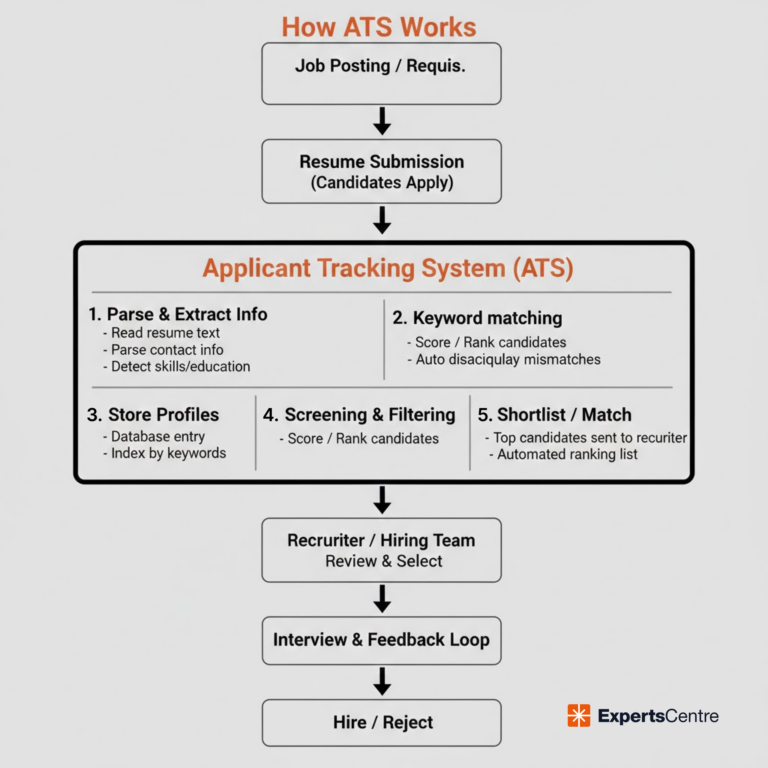
Harvard Business School’s research into “hidden workers” points to a big problem. They found that automated screening systems, which rely on these keywords, are a major reason good candidates get rejected. These systems use “very specific parameters” to minimise the applicant pool, often focusing on narrow keywords and exact credentials.
The report warns this leads companies to miss viable candidates who “could perform at a high level with training” but whose resumes don’t match the rigid keyword checklist.
In the Australian job market, recruiters like Debra O’Brien see two common mistakes:
An ATS friendly resume isn’t about trickery. It’s about clear, accurate communication. The goal is to speak the same language as the employer, not to spam an algorithm.
Stop thinking about “keywords” and start thinking about “skills language.” Here’s how:
Let’s look at some real examples. The key is to move from listing generic duties to describing specific achievements with impact. Here’s how to translate common weak phrases into powerful ‘skills language’ for both mid-level and senior roles:
Here is the table contrasting vague or generic terms with strong, results-oriented “skills language” for both mid-level and senior professionals. This demonstrates how to embed keywords effectively.
| Level | Don’t Use This (Vague/Weak) | Instead, Use This (Specific & Action-Oriented) | Why It Works |
|---|---|---|---|
| Mid-Level | “Responsible for social media” | “Grew LinkedIn follower base by 35% in 6 months through targeted content strategy.” | Uses the keyword “content strategy” and shows measurable impact with a number. |
| Mid-Level | “Handled customer service” | “Resolved escalated client issues, improving satisfaction scores by 15% and securing key account renewals.” | Embeds keywords like “client issues” and “account renewals” while highlighting problem-solving and value. |
| Mid-Level | “Assisted with projects” | “Coordinated cross-functional project timelines and deliverables using Asana, ensuring on-time launch for the Q3 campaign.” | Uses specific tools (Asana) and outcomes (on-time launch), incorporating keywords naturally. |
| Senior-Level | “Managed a team” | “Led a high-performing team of 12, fostering a culture of innovation that delivered a 20% increase in operational efficiency.” | The keyword “led” is stronger than “managed,” and it’s paired with a strategic outcome (culture, efficiency). |
| Senior-Level | “Improved processes” | “Spearheaded the digital transformation of the sales pipeline, integrating CRM systems that reduced reporting time by 50%.” | Keywords like “digital transformation” and “CRM systems” are framed within a leadership initiative with a clear ROI. |
| Senior-Level | “P&L responsibility” | “Directed P&L for the APAC region, executing a market-entry strategy that grew annual revenue by $2.5M within 18 months.” | Translates a common keyword (P&L) into a narrative of strategic leadership and quantifiable financial growth. |
Navigating the balance between ATS requirements and human appeal is tricky. It requires a strategic approach, not just a list of tips.
This is where professional CV writing makes a difference. At ExpertsCentre, our CV Upgrade Package is built on this exact principle. We analyse your target roles, identify the critical “skills language” for the Australian market, and weave it authentically into your career narrative.
We ensure your resume is optimised for the system and compelling to the recruiter like Debra, who has over 15 years of experience in ANZ recruitment. It’s the smarter way to approach resume keywords Australia.
Ready to move beyond keyword myths? Let’s optimise your resume the right way.
References:

Meet your Resume Expert
Upgrade your resume into one recruiters can’t ignore